

As security applications become more complex, a single viewing angle may not always be enough. Larger spaces, multi-directional monitoring, and target tracking can all create blind spots or limit the flexibility of a traditional single-lens camera.
This is where dual-lens security cameras offer more possibilities. Some combine different focal lengths for wide and close-up views, some expand the overall field of view, while others combine a fixed lens with a PTZ lens for continuous coverage and flexible tracking.
So, how do these designs differ, and what should brands, distributors, and sourcing teams consider when choosing a dual-lens security camera?
1. Common Dual-Lens Security Camera Designs
Dual-lens cameras can use different lens combinations and imaging approaches depending on the intended application. Here are three representative designs.
1.1 Hybrid Zoom
Hybrid Zoom dual-lens cameras typically combine a wide-angle lens with a telephoto lens. The two focal lengths provide broader coverage and a closer view of distant targets, while digital zoom adds flexibility when viewing subjects at different distances.
This design helps balance overall coverage with distant detail, making it suitable for applications that require monitoring across different viewing distances.
1.2 Ultra-Wide / Panoramic
This design uses two lenses to extend the camera’s overall field of view. Some models further stitch both feeds into a continuous ultra-wide or panoramic image.
The main benefit is broader coverage with fewer blind spots, making it suitable for monitoring larger areas. Image distortion, stitching quality, and performance around the image boundaries are also worth considering when evaluating panoramic solutions.
1.3 Fixed + PTZ
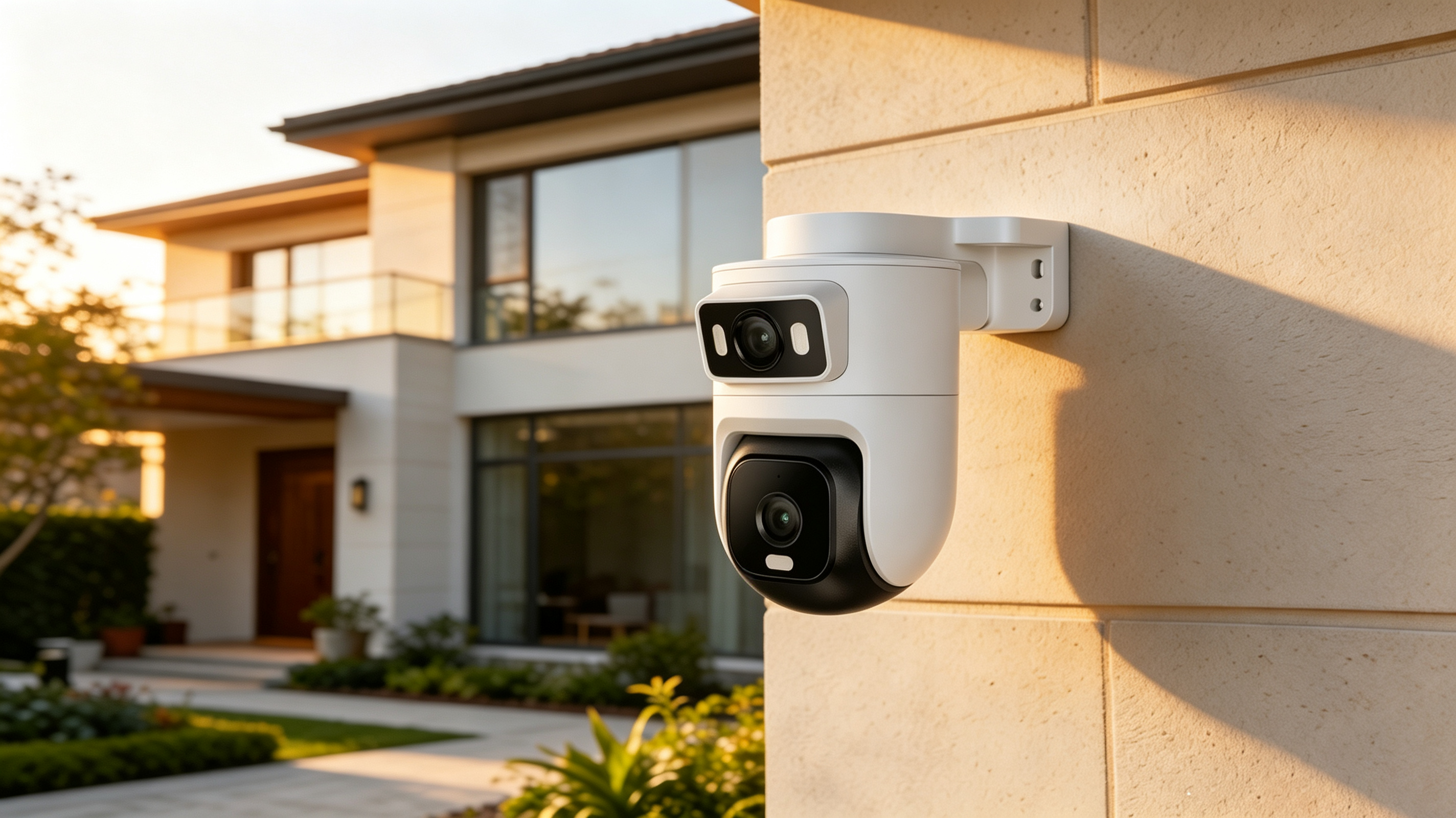
A Fixed + PTZ dual-lens camera combines a stable monitoring view with more flexible observation and tracking.
The fixed lens continuously monitors a predefined area, while the PTZ lens can change direction and, depending on the product configuration, track moving targets.
When the PTZ lens turns toward activity elsewhere, the fixed lens can continue monitoring the original area. This allows users to keep the overall scene in view while following activity in another direction, making the design well suited to applications requiring both continuous coverage and flexible tracking.
2. What Should You Look for in a Dual-Lens Security Camera?
Once the right dual-lens architecture has been identified, several core specifications can help determine whether the camera is suitable for the intended application.
2.1 Resolution & Image Quality
Resolution directly affects how much visual information and detail a security camera can capture. Higher-resolution footage provides a stronger basis for identifying people and objects, reviewing events, and examining specific areas during playback.
However, resolution alone does not determine image quality. The image sensor, lens, aperture, ISP processing, and other components of the imaging system also affect the final result.
Learn More: Why Do Security Cameras With the Same Resolution Deliver Different Image Quality?
2.2 Night Vision
Security cameras often need to operate around the clock, making night vision essential for reliable monitoring in low-light environments.
Common solutions include infrared night vision, full-color night vision with supplemental lighting, smart dual-light night vision, and ultra-low-light / black-light imaging. When comparing cameras, consider not only the stated night vision range but also nighttime clarity, color requirements, illumination method, and available night vision modes.
Learn More: Night Vision Decoded: IR vs. Standard Full-Color vs. Starlight Full-Color
2.3 Network Connectivity
A stable network connection directly affects live view, remote monitoring, event notifications, cloud services, and overall app performance.
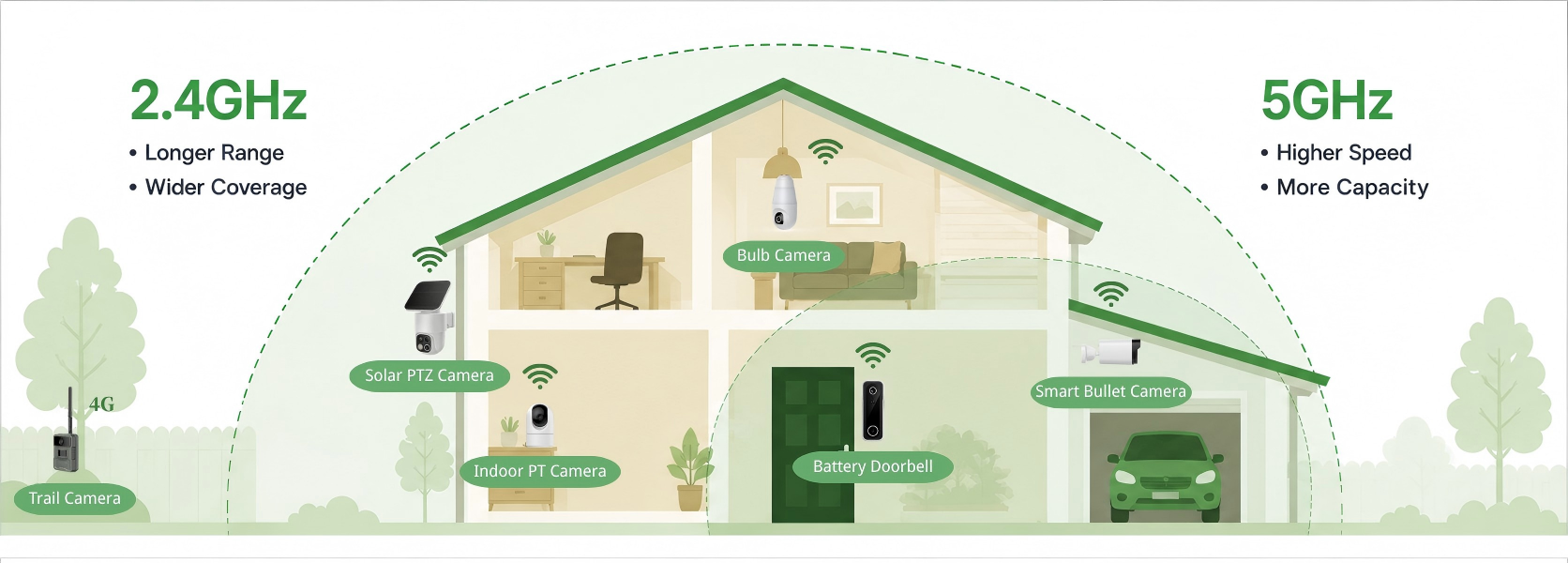
For Wi-Fi security cameras, 2.4GHz generally provides wider coverage, while 5GHz offers higher data transmission capacity. Dual-band 2.4GHz / 5GHz Wi-Fi provides greater flexibility across different network environments, while newer standards such as Wi-Fi 6 can further improve wireless performance under compatible conditions.
For outdoor or remote locations without reliable Wi-Fi, 4G/5G cellular security cameras may be a better option.
Learn More: 2.4GHz Wi-Fi vs. 5GHz Wi-Fi: What’s the Difference for Security Cameras?
2.4 Lens Configuration
Lens configuration determines how a camera sees the monitored area, affecting its field of view, observation distance, and overall image composition.
For dual-lens cameras, the way the two lenses work together is particularly important. Wide-angle + telephoto, ultra-wide dual-lens, and Fixed + PTZ configurations are designed for different monitoring needs.
Rather than simply asking whether a camera is “dual-lens,” consider:
What does each lens do, and does that combination fit the intended application?
2.5 Smart Detection & Motion Tracking
Modern smart security cameras can combine motion and sound detection with AI-based human, vehicle, pet, and other target recognition.
On cameras with PTZ capabilities, detection can also work with motion tracking, allowing the movable lens to follow relevant activity automatically.
Instead of comparing only the number of AI features, consider whether the detection targets, alert methods, and tracking capabilities match the intended use case.
2.6 Dual-View Experience
A second lens only adds real value when the two views work effectively together.
Can both video feeds be viewed and recorded simultaneously? How are they displayed in the app? When the PTZ lens tracks a target, does the fixed lens continue monitoring the original area?
Beyond hardware specifications, the dual-view live feed, recording, event alerts, playback, and app experience are all worth evaluating before selecting a dual-lens camera.
3. Golden Vision M2: 6MP Fixed + PTZ Dual-Lens Security Camera
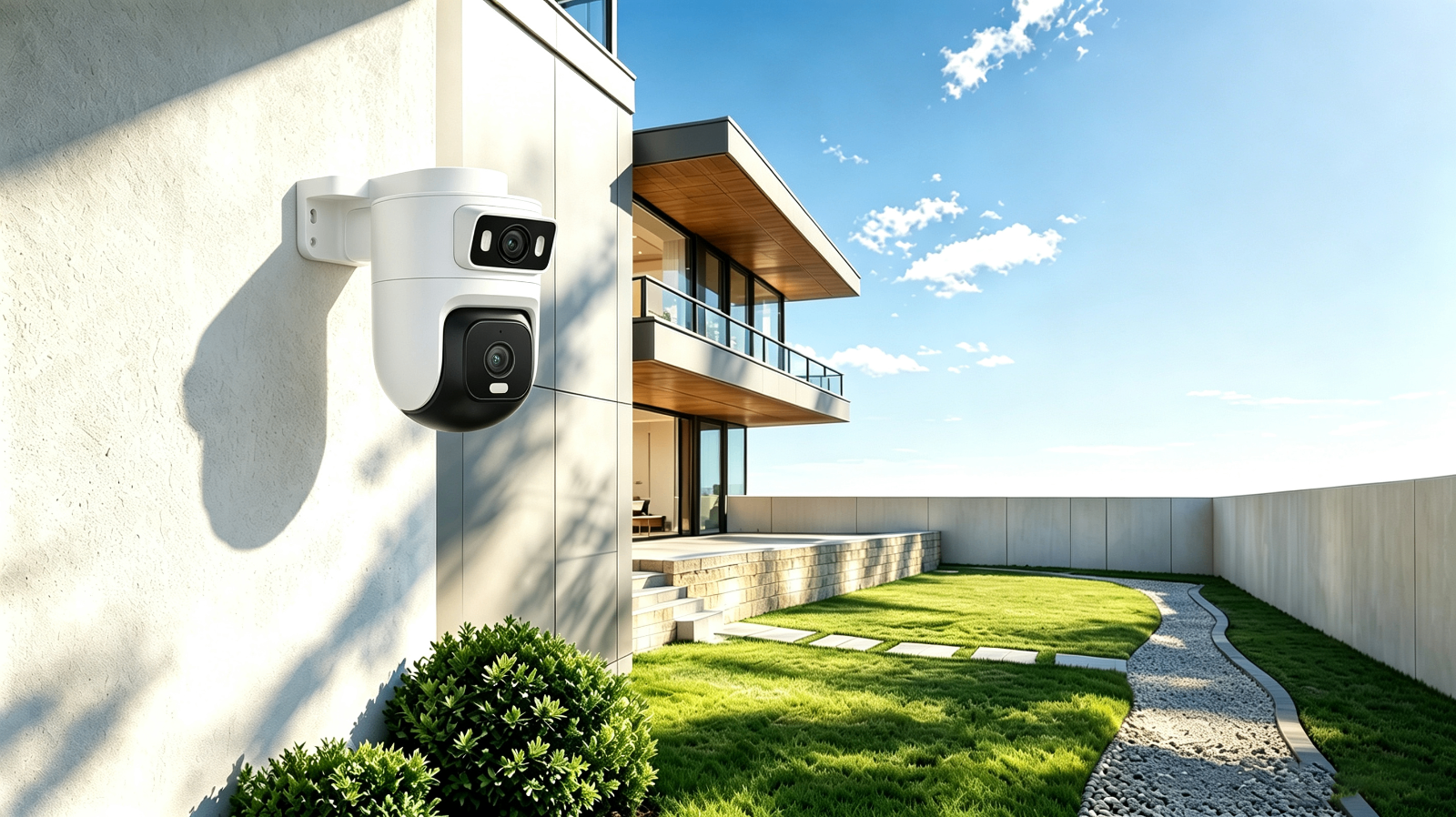
Designed for flexible multi-view monitoring, the Golden Vision M2 combines a fixed monitoring view with a flexible PTZ view. When the PTZ lens tracks activity, the fixed lens continues monitoring the original area, helping users maintain awareness of the overall scene.
M2 features dual 1/3" CMOS sensors and two F1.6 / 3.8mm starlight fixed-focus lenses, delivering 6MP dual-lens imaging (2 × 3MP). It supports simultaneous live viewing and recording of two 3MP video streams, allowing both monitoring views to be displayed at the same time.
For nighttime monitoring, M2 features smart dual-light night vision with 6 infrared LEDs and 4 white LEDs, an IR night vision range of up to 8–10 meters, and intelligent switching between infrared and full-color night vision.
It also supports motion detection, human detection, sound detection, motion tracking, Privacy Mode, 2.4GHz / 5GHz dual-band Wi-Fi, Bluetooth and QR code pairing, along with local and cloud storage and remote monitoring via iOS and Android.
With 6MP dual-lens imaging, Fixed + PTZ dual views, simultaneous dual-view monitoring, smart dual-light night vision, intelligent tracking, and IP65 weather resistance, M2 provides a flexible multi-view solution for smart security applications.
About Golden Vision
Golden Vision specializes in smart security, smart home, and smart pet products, with solutions covering indoor, residential outdoor, and remote outdoor applications. We provide OEM/ODM products and solutions for brands, distributors, and business partners worldwide.
From product definition and industrial design to hardware and software development, platform integration, and mass production, Golden Vision provides flexible development and customization support for different markets, channels, and application requirements.
Looking for smart security cameras, smart home products, smart pet products, or OEM/ODM solutions?
Contact Golden Vision to request our latest product catalog, discuss your next project, or explore customization opportunities.